What Is Enterprise Data Management? A Practical 2026 Guide
What is enterprise data management? It's how you govern, integrate, and secure data across every system. See how AI fits in, no migration required.
By Artificial Wit Team
By Artificial Wit Team. Last updated: August 8, 2026.
Enterprise data management (EDM) is the set of practices, processes, and governance a company uses to collect, integrate, secure, and get value from its data. It spans every system a company runs, not just one department's database. It covers five core disciplines: master data management, data governance, data quality, data integration and architecture, and data security and lifecycle management.
Ask ten IT leaders to define it and you'll get ten slightly different answers, which is itself part of the problem. Enterprise data management sounds like a solved category, the kind of thing with a tidy Wikipedia definition and a shelf of vendor whitepapers. In practice, most companies run it as a patchwork. A data warehouse project sits 60% done. A governance policy exists, but nobody enforces it. Three different systems each think they hold the "real" customer record.
This guide covers what enterprise data management actually includes. It explains why the traditional fix, a multi-year platform migration, is often the most expensive path to the same outcome. And it covers where AI genuinely changes what's possible, without requiring you to rebuild your data stack first.
- Enterprise data management covers five disciplines: master data management, governance, quality, integration/architecture, and security/lifecycle.
- Gartner estimates poor data quality costs organizations an average of $12.9 million a year, and most companies don't even measure the number.
- The traditional fix, a company-wide data warehouse or MDM platform migration, typically takes 12-24 months and often stalls before delivering value.
- AI (through MCP and RAG) adds a query layer on top of your existing systems, so teams can get governed answers from real data before a migration finishes, not instead of doing the underlying data work.
- Access control has to travel with the data. An AI layer that ignores existing permissions isn't solving data governance, it's bypassing it.
What Is Enterprise Data Management?
Enterprise data management is the discipline of treating a company's data as a shared, governed asset. No single department or application owns it independently. The DAMA-DMBOK, the industry-standard framework maintained by DAMA International, breaks this into functional areas most practitioners still reference today. They include data governance, architecture, modeling, storage, security, integration, and quality, plus master, reference, and metadata management.
In plain terms: EDM is the answer to "who owns this data, is it accurate, can the right people find it, and does it mean the same thing in every system that uses it?"
That last question trips up more companies than any other. A "customer" in your CRM, your ERP, and your billing system often isn't the same record. Everyone assumes it is, until a report comes back wrong.
The Five Core Components of an EDM Strategy
A working enterprise data management strategy touches five areas. Skip one, and the others tend to fail quietly rather than obviously.
- Master data management (MDM): A single, trusted definition of core business entities, customers, products, vendors, locations, so every system references the same record instead of maintaining its own copy.
- Data governance: The policies, roles, and decision rights that determine who owns data, who can access it, and how quality issues get resolved. Governance without enforcement is just a document.
- Data quality: Ongoing measurement and correction of accuracy, completeness, and consistency, not a one-time cleanup project.
- Data integration and architecture: How data moves and connects between systems, APIs, ETL pipelines, data warehouses, so information doesn't get stranded in silos.
- Data security and lifecycle management: Access control, retention policy, and compliance, covering data from creation through archival or deletion.
Most EDM initiatives fail because they treat one of these as the whole project. A data quality tool without governance just automates cleaning the same mess repeatedly. A governance policy without integration has no way to actually enforce consistency across systems.
Curious how AI fits into an existing data strategy rather than replacing it? See how Artificial Wit's AI Assistant works with your current systems.
Why Enterprise Data Management Actually Matters
The cost of skipping this isn't abstract. According to Gartner's data quality research, poor data quality costs organizations an average of $12.9 million annually. Roughly 60% of companies don't even measure the figure. That means they're absorbing the cost without knowing its size.
Teresa Alvarez ran data architecture for a mid-size industrial manufacturer. For years, the company's SAP instance and its Salesforce CRM each maintained their own version of customer records. Nobody had explicitly decided which one was authoritative. In March 2026, that gap caused real damage: a shipping address updated in Salesforce had never synced to SAP, and a $340,000 equipment order shipped to the customer's old facility. The mistake wasn't a data entry error. It was a missing master data policy that let two systems disagree about the same customer for eleven months without anyone noticing.
That's the pattern behind most EDM failures. It's rarely a single dramatic breach. It's a slow accumulation of small inconsistencies, a wrong shipment, a duplicate invoice, a compliance report built on stale numbers, that eventually costs real money.
The Traditional EDM Playbook, and Where It Breaks Down
The standard response to a problem like Teresa's is a platform project. Consolidate everything into one data warehouse, or roll out a dedicated MDM platform across every business unit. On paper, this is the correct long-term fix. In practice, it's also where most EDM budgets go to stall.
Noah Kessler was IT director at a logistics company. In early 2025, his team greenlit an 18-month enterprise data warehouse consolidation, meant to unify records across seven regional systems into one governed source of truth. By month 14, the project had used most of its budget. Only three of the seven systems were migrated. Business users still couldn't get a straight answer to "how many active shipments do we have in the Southeast region right now." The warehouse, once finished, would solve that. Until then, nothing had actually changed for the people asking daily questions.
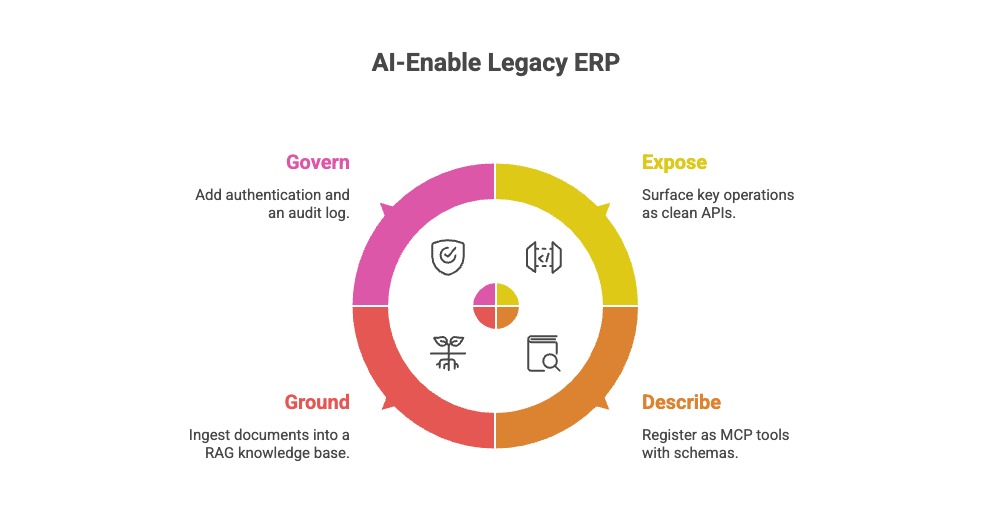
This isn't an argument against doing the underlying data work. It's a specific, common failure mode: treating the migration as the only path to value. Nobody gets anything usable until the entire project finishes. AI-enabling a legacy ERP without re-platforming follows the same logic in a narrower context. Systems you already run don't have to be replaced before they become useful.
Where AI Changes the Equation
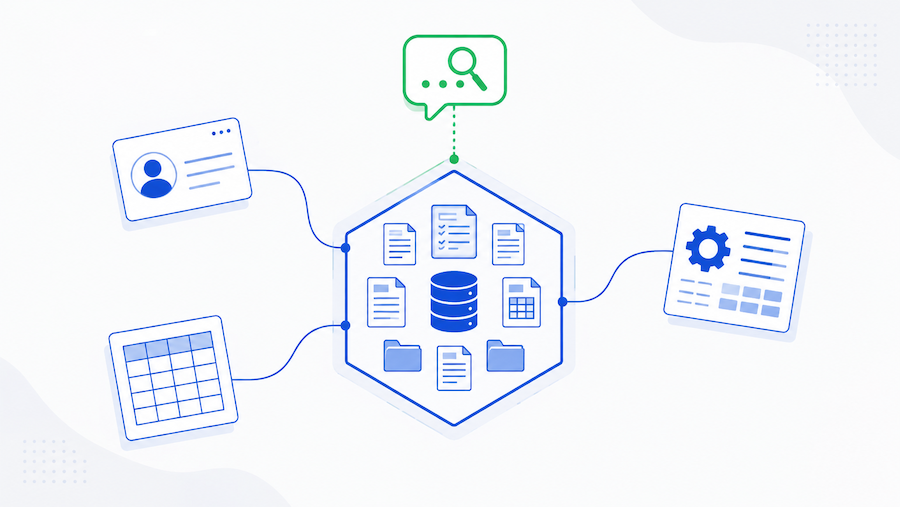
Here's the part most traditional EDM guides don't cover, because the mechanism is new: AI, specifically Model Context Protocol (MCP) and retrieval-augmented generation (RAG), gives you a query layer on top of your existing systems. The underlying governance work continues in parallel, not instead of it.
An MCP server exposes operations from your existing systems as tools an AI model can call directly. That works whether the system is an ERP, a CRM, or a data warehouse that's still half-migrated. It doesn't require your data to already be perfectly unified. It only requires the systems that hold the data today to be reachable through an API. Most already are.
RAG handles the other half: grounding AI answers in your actual documents and records, with citations, instead of letting a model guess. Combined, these two mechanisms change the timeline. A business user can ask "what's our current customer count in the Southeast region" and get an answer pulled from live data today, not after the 18-month warehouse project finishes.
| Traditional Platform Migration | AI Query Layer (MCP + RAG) | |
|---|---|---|
| Time to first usable answer | 12-24 months, after the platform ships | Days, once the first system is connected |
| Data prerequisite | Fully unified, migrated data | Existing systems, reachable through an API |
| Governance | Rebuilt as part of the new platform | Inherited from existing role-based permissions |
| Scope | Whole data estate at once | One system or question at a time, expands incrementally |
Grace Odom led operations for a regional distributor. Through most of 2025, she fielded the same question from three different department heads: "what does our current vendor list actually look like." Each time, someone exported a report, cross-checked it against a second system, and emailed back an answer that was already a day old. Once vendor and inventory data were reachable through an MCP-connected AI assistant, that changed. The same question became a typed query with an answer in under a minute, pulled from the live system instead of last week's export.
This doesn't replace master data management, governance, or data quality work. A model answering questions from ungoverned, low-quality data just returns wrong answers faster. What it changes is the sequencing. Teams stop waiting for the full platform migration to get value from data they already have. Grounded, permission-aware answers become available immediately instead.
Want to see this work against your own systems? Sign up free, no credit card required, and connect your first API or data source.
Building an AI-Ready EDM Strategy Without a Platform Migration
If a full data warehouse or MDM rollout isn't realistic this year, here's a sequence that gets real value sooner without abandoning the longer-term governance work.
- Identify the systems that actually get asked questions. Not every database needs an AI layer on day one. Start with the two or three systems your teams query manually and repeatedly, ERP, CRM, inventory.
- Expose the operations that matter as tools, not the whole schema. You don't need every field queryable. Start with the 10-20 lookups and reports people actually request.
- Ground answers in your documents, not just structured tables. Policies, SOPs, and contracts often hold the context that explains what the numbers mean. A knowledge base with retrieval covers both.
- Apply access control at the AI layer, not around it. Whatever role-based permissions already govern who sees what in your source systems should carry through to the AI. Artificial Wit's security model enforces this by default. The AI only returns what the requesting user is already permitted to see.
- Keep the governance and quality work moving in parallel. The AI layer makes existing data more useful. It's not a substitute for fixing the master data problem that caused Teresa's $340,000 shipping error in the first place.
Common Enterprise Data Management Mistakes to Avoid
- Treating data quality as a one-time cleanup. Without ongoing measurement, records drift out of sync again within months.
- Writing a governance policy nobody enforces. A data ownership document that isn't tied to actual access controls or accountability doesn't change behavior.
- Waiting for a full migration before delivering any value. Noah's 18-month project left business users without answers for over a year. A query layer on the existing systems could have helped immediately.
- Letting an AI tool bypass existing permissions. Any AI layer that returns data a user wouldn't otherwise be authorized to see isn't a shortcut. It's a new compliance problem.
- Assuming EDM is IT's problem alone. Who owns the "customer" record and what counts as accurate are business decisions. IT can enforce them, but shouldn't have to make the call alone.
Frequently Asked Questions
What is enterprise data management in simple terms?
It's the discipline of treating company data as a shared, governed asset, covering master records, quality, integration, and security. No single system or department manages it independently.
What's the difference between enterprise data management and master data management?
Master data management is one component of enterprise data management, specifically, maintaining a single trusted version of core entities like customers and products. EDM is the broader discipline that also includes governance, quality, integration, and security.
Do I need a data warehouse to do enterprise data management well?
No. A data warehouse helps with integration and reporting, but governance, quality, and security work can, and should, start before any platform migration finishes. Waiting for the warehouse often delays value for a year or more.
How does AI fit into an enterprise data management strategy?
AI, through MCP and RAG, adds a query layer on top of existing systems. People can ask questions and get grounded answers today, without requiring the underlying data to already be perfectly unified. It works alongside governance and quality efforts, not instead of them.
Can AI make bad enterprise data management worse?
Yes, if governance and access control aren't in place first. An AI model answering questions from ungoverned or low-quality data just delivers wrong answers with more confidence. Permission-aware retrieval and grounded citations are what keep this from happening.
Getting Started With Enterprise Data Management
Enterprise data management isn't a project with a finish line. It's an ongoing discipline: master data, governance, quality, integration, and security, all maintained together rather than in isolation. Teresa's $340,000 shipping error and Noah's stalled 18-month migration both trace back to the same root cause: treating one piece of EDM as the whole solution while the rest stayed unmanaged.
The good news is that you don't have to choose between "start the multi-year platform project" and "keep getting wrong answers from disconnected systems." Grace's team got governed, real-time answers from existing systems while the longer-term data work continued underneath. That sequencing works because it delivers value now while the deeper data work keeps improving things later. It's the practical way most companies actually make progress on enterprise data management.
Start with the systems your teams already query manually every week. Expose the operations that matter. Ground the answers in your real documents. Make sure access control travels with the data instead of getting bolted on afterward.
Sign up free, no credit card required, and see how your existing systems become queryable without waiting for a migration to finish.
Related reading
Ready to put this into practice?
Talk to us about your stack