Second Brain for Business: How AI Memory Layers Ground Every Team
What's a second brain for business? See how an AI memory layer for enterprise teams delivers grounded AI answers and role-aware responses. Try it free.
By Artificial Wit Team
By Artificial Wit Team. Last updated: July 9, 2026.
A second brain for business is a memory layer that sits underneath your AI tools and gives every agent the same grounded context: your org's rules, your knowledge base, your live systems, and your users' roles. Without it, every AI session starts from zero, re-explaining policies and re-searching documents.
Priya ran platform ops for a mid-size logistics company, and every week looked the same. A new hire asked the support bot a question about return policy, got a generic answer, then pinged Priya directly because the bot hadn't been told the actual SLA terms. A different agent, built by a different team, answered confidently from a document that had been superseded three months earlier. Neither failure was the model's fault. Neither agent had a memory that persisted, was current, or respected who was asking.
That's the gap a second brain for business closes. Not a smarter model, a shared memory layer underneath every model.
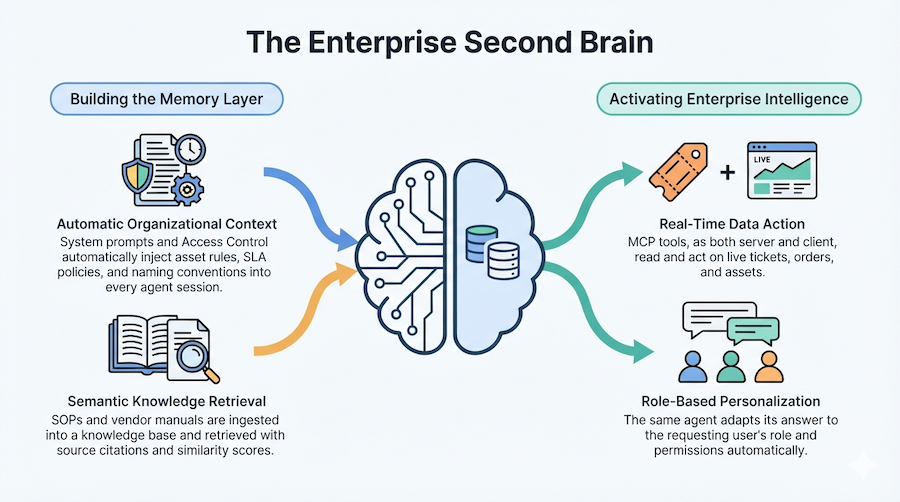
- An enterprise AI second brain has two halves: a memory layer (organizational context + semantic knowledge retrieval) and an intelligence layer (real-time data action + role-based AI personalization).
- It's not a single feature. It's four already-shippable mechanisms working together: system prompts with Access Control, a RAG knowledge base, MCP tools, and per-role permissions.
- Interaction workers lose nearly 20% of the workweek searching for internal information, according to McKinsey Global Institute's "The Social Economy" report.
- AI-related financial losses hit 99% of surveyed organizations in 2025, averaging $4.4M per affected company, per EY's Responsible AI Pulse Survey, much of it traceable to ungrounded answers.
- The mechanism that fixes this is the same one that fixes hallucination: retrieval with citations, not a bigger model.
What Is a Second Brain for Business?
A second brain for business is a shared memory and action layer that every AI agent in an organization draws from, instead of each agent starting cold with only what's in its prompt. It stores organizational rules and documents (the memory layer), then connects that memory to live systems and role-aware responses (the intelligence layer), so any agent — support bot, sales copilot, compliance assistant — answers from the same grounded context.
The term borrows from personal knowledge management (Tiago Forte's "second brain" for individual notes and ideas), but the enterprise version solves a different problem. It's not one person's notes. It's an organization's rules, documents, and live data, made available to many agents, many users, and many roles at once, with permissions intact.
For an individual, a second brain is a personal archive. For a business, it has to work the same way for a hundred different employees at once, each with a different role, without a hundred separate setups.
Building the Memory Layer
The AI memory layer for enterprise teams is the half of the second brain that doesn't change often — your organization's rules and its documents. Two mechanisms build it.
Automatic Organizational Context
Every AI session should already know your asset rules, SLA policies, and naming conventions, without a human re-typing them into a prompt. In Artificial Wit, this runs through agent system prompts combined with Access Control: an agent is configured once with the organizational rules it needs, and every session it handles inherits that context automatically.
This is the fix for Priya's first failure. The support bot didn't need a better model. It needed the actual SLA terms injected into its context before the conversation started, not left for a human to correct after the fact.
Semantic Knowledge Retrieval
Documents drift out of date, get superseded, or get buried three folders deep. Semantic knowledge retrieval solves this with retrieval-augmented generation: SOPs and vendor manuals get ingested into a knowledge base once, and every answer pulled from them carries the source document, a similarity score, and a reference number.
That's the fix for Priya's second failure. The agent citing an outdated policy wasn't hallucinating in the strict sense. It was grounded in a real document that had simply been superseded. A knowledge base with visible embedding status (Pending, Embedding, Ready, Failed) and a straightforward re-ingestion step catches that before it reaches a customer.
Activating Enterprise Intelligence
Memory alone is passive. The second half of a second brain for business turns that memory into something agents can act on and personalize.
Real-Time Data Action
A second brain that only answers questions from static documents misses half the job. The other half is MCP tools reading and acting on live tickets, orders, and assets. It's not just recalling what a document said last quarter — it's checking what's true right now.
Artificial Wit does this both directions. As an MCP server, it exposes your own APIs — SAP, Oracle, Salesforce, NetSuite, internal tools — as callable tools any MCP-compatible client can use. As an MCP client, it connects out to external MCP servers your team already runs, handling the OAuth and transport-protocol differences so nobody has to configure that by hand.
| Direction | What it does | Example |
|---|---|---|
| MCP server | Exposes your APIs as tools | An agent looks up a live order status in NetSuite |
| MCP client | Connects to external MCP servers | An agent reads from a third-party ticketing MCP server without custom integration work |
Role-Based AI Personalization
The same question from two different users should sometimes get two different answers, not because the model changed, but because the asking user's role did. Role-based AI personalization means responses adapt to specific user roles and preferences automatically, without repetitive instructions re-explaining who the user is every session.
This runs on the same Access Control model that governs every resource in Artificial Wit — agents, knowledge bases, LLM models, APIs, and more — each either Public or Restricted to specific roles and users. A support rep and a finance manager asking the same agent the same question can get correctly different answers, because the retrieval and the response both respect who's actually asking.
Want the full permission model? See how Access Control works across every resource type in the white-label platform breakdown.
Why Enterprises Need a Second Brain Now
The cost of not having one shows up in two places: wasted time and ungrounded answers. See how teams apply this across support, sales, and compliance.
Interaction workers spend nearly 20% of the workweek looking for internal information or tracking down colleagues who can help, according to McKinsey Global Institute's "The Social Economy" report. That's the exact time a memory layer with semantic retrieval and organizational context is built to reclaim. An agent that already knows the SLA policy doesn't need a human to go find it.
The ungrounded-answer cost is larger and more expensive. In EY's Responsible AI Pulse Survey of 975 C-suite leaders, 99% of organizations reported financial losses from AI-related risks in 2025, 64% of them over $1 million, averaging $4.4 million per affected company. Hallucination and misinformation were cited by 53% of respondents globally as a common AI risk driving those losses.
Trust hasn't caught up either. Stack Overflow's 2025 Developer Survey found trust in AI accuracy fell to 29%, down from 40% the year before, even as 84% of respondents kept using AI tools daily. People are using AI more and trusting it less, because the mechanism connecting answers to real, current, permission-respecting data hasn't been the default.
A second brain for business is the direct answer to that gap. It delivers grounded AI answers instead of an unsupported claim, live system access instead of a static snapshot, and role-aware responses instead of one-size-fits-all output.
Second Brain vs. a Regular Chatbot or Knowledge Base
| Regular chatbot | Static knowledge base | Enterprise second brain | |
|---|---|---|---|
| Organizational rules | Re-typed per prompt, if at all | Not applicable | Injected automatically via system prompt + Access Control |
| Document retrieval | None, or unsourced | Keyword search, no citations | Semantic retrieval with source + similarity score |
| Live system data | No | No | MCP tools read/act on live tickets, orders, assets |
| Response personalization | Same answer for every user | Not applicable | Adapts by role automatically |
The distinction that matters most is the third row. A chatbot or a document search tool can answer questions about the past. A second brain can also act on the present, because the memory layer is wired to live systems, not just a document store.
Getting Started: Build Your Second Brain for Business
Building a second brain for business doesn't require a separate infrastructure project. It's four configuration steps on top of a platform you're likely already evaluating for other reasons.
- Set up your organizational context. Configure an agent's system prompt with your asset rules, SLA policies, and naming conventions, and set its Access Control. This is the step that would have caught Priya's first failure before it reached a customer.
- Build the knowledge base. Ingest your SOPs and vendor manuals, and confirm embedding status reaches Ready before relying on it. Superseded documents should be re-ingested, not left live alongside their replacements.
- Connect real-time data. Expose an internal API as an MCP tool, or connect to an external MCP server your team already uses, so the agent can act, not just answer.
- Assign roles. Set which users and roles can access the agent, the knowledge base, and any connected tools, so personalization follows automatically.
Most teams get the memory layer and one live data connection working in a single session, then expand the knowledge base and tool set from there. Adding a second agent later doesn't mean redoing this setup. It means pointing a new agent at the same organizational context, knowledge base, and Access Control model the first one already uses.
Frequently Asked Questions
What is a second brain for business?
A second brain for business is a shared memory and action layer that gives every AI agent in an organization the same grounded context. That context includes organizational rules, retrieved documents with citations, live system data, and role-aware permissions, instead of each agent starting from scratch.
How is a second brain different from a regular knowledge base?
A knowledge base stores documents and can answer questions about them. A second brain adds two things a knowledge base alone doesn't have: automatic organizational context injected into every session, and live data action through connected tools, not just retrieval from static files.
Does a second brain stop AI hallucinations?
It reduces them significantly by grounding every answer in retrieval, source documents, similarity scores, and reference numbers, rather than letting a model generate an unsupported claim. It doesn't eliminate every risk on its own, which is why citations stay visible for human verification.
Can different users get different answers from the same agent?
Yes. Role-based personalization means the same agent adapts its response based on the requesting user's role and permissions, without needing separate agents or repeated manual instructions per user.
Do I need to migrate my existing systems to build a second brain?
No. The real-time data action layer wraps existing APIs, SAP, Oracle, Salesforce, NetSuite, internal tools, as MCP tools. Your systems of record stay exactly where they are.
The Memory Layer Your AI Was Missing
Priya's two failures both trace back to the same root cause: neither agent had a memory that was current, sourced, or aware of who was asking. A second brain for business fixes that by pairing a memory layer (organizational context plus semantic retrieval) with an intelligence layer (real-time data action plus role-based personalization).
None of the four pieces is exotic on its own. What changes the outcome is running them together on one platform, instead of stitching together a prompt template, a document search tool, custom API integrations, and a separate permissions system that don't share context with each other. That's the architecture behind Artificial Wit: one platform from the start, not five disconnected projects bolted together.
Sign up free, no credit card required, and configure your first agent against a real knowledge base, a live API, and role-based Access Control in one session.
Related reading
Ready to put this into practice?
Talk to us about your stack