AI for Contract Review: Grounded Extraction, Not a Fifth Legal Tool
Struggling to trust AI contract summaries? AI for contract review cites its source on every clause, so legal teams verify instead of guess. Sign up free.
By Artificial Wit Team
By Artificial Wit Team. Last updated: July 9, 2026.
AI for contract review means using retrieval-augmented generation to extract, summarize, and compare contracts and SOWs. Every answer carries the source clause, a similarity score, and a reference number, so legal teams can verify a summary instead of trusting it blind. It runs on the same knowledge base and Access Control model already grounding support and ERP answers — not a separate legal-tech platform.
Naomi ran contract operations for a mid-size SaaS company. Renewal season meant the same ritual every quarter: pull the last three amendments, cross-reference the SOW against the master agreement, and flag anything that had quietly drifted from standard terms. She'd tried an AI summarizer once. It produced a clean paragraph and zero way to check whether the paragraph was actually right. She stopped using it after the second wrong date.
That's the gap grounded contract review closes. Not a smarter summary, a summary with the receipts attached.
- AI contract review only earns trust when every extracted clause or comparison carries a source document, a similarity score, and a reference number, not just a confident paragraph.
- This runs on the same RAG Knowledge Base and Access Control model already used for support and ERP use cases, no separate legal-tech platform to adopt.
- In-house legal teams using AI in contract review report saving 14 hours per week, per GC AI's December 2025 survey of 100+ in-house teams.
- Adoption is accelerating fast: the share of legal teams actively using AI in contract review doubled year-over-year, per LegalOn's December 2025 survey of 452 in-house professionals.
- Role-based Access Control matters here specifically, contract content is often restricted to legal and compliance roles only, and retrieval needs to respect that.
What Is AI Contract Intelligence?
AI contract intelligence is the use of retrieval-augmented generation to extract clauses, summarize terms, and compare contracts or SOWs against each other. Citations get attached to every claim, so a human reviewer can verify the source instead of trusting an unsupported summary. It's grounding applied to legal documents specifically — the same mechanism, a different document type.
The distinction that matters: a generic AI summarizer generates a plausible-sounding paragraph. Contract intelligence generates an answer plus the exact clause, page, or section it came from, with a similarity score showing how confident the retrieval was.
How Grounded Contract Extraction Works
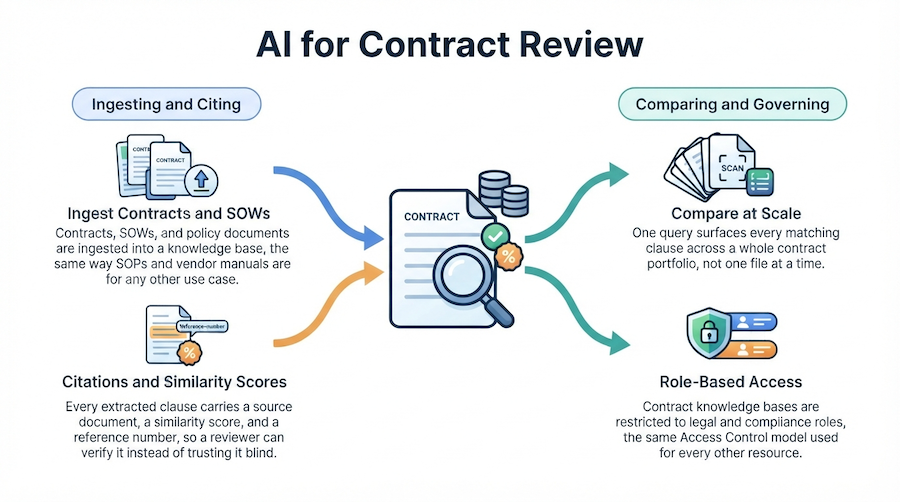
As a legal document extraction AI, this mechanism doesn't treat contracts as a special case. It applies the same ingest-then-cite discipline used for any other document type — just pointed at contracts and SOWs instead of SOPs or vendor manuals.
Ingesting Contracts and SOWs Into a Knowledge Base
Contracts, SOWs, and policy documents get ingested into a knowledge base the same way SOPs and vendor manuals do for any other use case. Embedding status stays visible (Pending, Embedding, Ready, Failed), so a legal team knows exactly which documents are actually queryable before relying on an answer.
This is the fix for Naomi's first problem. A superseded amendment sitting alongside its replacement doesn't quietly confuse an answer. Re-ingesting the current version keeps retrieval pointed at what's actually live.
Citations and Similarity Scores for Audit-Ready Answers
Every extracted clause or comparison carries the source document, a similarity score, and a reference number. Grounded retrieval is what makes an AI-generated contract summary usable in an audit-sensitive context. The answer isn't just plausible — it's traceable back to the exact passage that produced it.
That's the fix for Naomi's second problem. When a comparison flags a clause as non-standard, she can click through to the actual source language in seconds, instead of re-reading the whole document to confirm the AI got it right.
Contract Comparison and Clause Extraction at Scale
Comparing a new SOW against a master agreement, or checking one hundred vendor contracts for a specific indemnification clause, is a retrieval problem at scale: the same grounding mechanism, run across many documents instead of one. A legal team defines what to look for. The knowledge base surfaces every matching passage with its source and confidence score, rather than a human manually opening each file.
Consider a renewal-season vendor audit, the kind Naomi's team ran every quarter. Instead of opening each vendor contract individually to check for auto-renewal clauses with non-standard notice periods, an agent queries the full contract knowledge base once. It surfaces every matching clause across all vendors with its source document attached. What used to take a paralegal a full week of manual cross-referencing becomes a query a legal ops lead can run and verify in an afternoon, because every result still points back to the exact passage that produced it. Used this way, it functions as an AI tool for contract and SOW comparison run against a whole portfolio at once, rather than a human opening one file at a time.
| Manual review | Ungrounded AI summary | Grounded contract intelligence | |
|---|---|---|---|
| Speed at scale | One document at a time | Fast, but unverifiable | Fast, with a source per claim |
| Trust | High, but slow | Low, no way to check | High, citation-backed |
| Audit trail | Manual notes | None | Source document + similarity score + reference number |
| Access control | Manual file permissions | Rarely enforced | Role-based, same model as every other resource |
Who Can See What: Role-Based Access for Legal Content
This is why AI for compliance document review needs governance built in from the start. Contract content is often more sensitive than general knowledge-base material, and not every employee should be able to query active vendor agreements or compensation-adjacent SOWs. The same Access Control model governs every resource type — agents, knowledge bases, APIs, users — and applies here too: contract-related knowledge bases can be restricted to legal and compliance roles specifically, while the underlying mechanism stays identical to how any other knowledge base is governed.
Want to see the permission model firsthand? Explore Artificial Wit's AI Assistant to check the Access Control screen yourself.
Why AI for Contract Review Doesn't Require a New Legal-Tech Platform
Most contract intelligence software is a fifth system to adopt: a new login, a new export step, a new place documents have to live. Grounded contract intelligence here runs on the same knowledge base and Access Control model already grounding a support assistant or an ERP copilot. Contracts are just one more use case on infrastructure that already exists.
That distinction shows up fastest in the numbers. In-house legal teams using AI in contract review report saving 14 hours per week, according to GC AI's December 2025 customer survey of over 100 in-house teams. Adoption is moving quickly to capture that time back: the share of legal teams actively using AI in contract review doubled year-over-year, according to LegalOn's December 2025 survey of 452 in-house legal professionals. Neither number requires believing in a new platform. Both describe teams applying grounded retrieval to documents they already had.
For a legal team already running other AI-assisted workflows, support grounded in product docs, an ERP copilot answering finance questions, the marginal cost of adding contracts is small: one more knowledge base, governed by the same Access Control model, queried by an agent configured the same way as any other. That's a meaningfully different starting position than evaluating, procuring, and onboarding a standalone contract-AI vendor with its own security review, its own integration project, and its own separate login for a team that already has enough logins.
Getting Started
- Ingest your contracts and SOWs. Upload active agreements, amendments, and policy documents into a knowledge base, and confirm embedding status reaches Ready before treating any document as queryable.
- Set Access Control for legal content. Restrict the contract knowledge base to legal and compliance roles before opening it to a broader agent, contract terms are rarely appropriate for company-wide access.
- Configure an agent for extraction or comparison. Point it at the contract knowledge base and define what to extract, a clause type, a comparison target, a policy check, in its system prompt.
- Verify the citation trail on the first few answers. Confirm the source document, similarity score, and reference number actually resolve to the right passage before relying on it at scale across a full contract portfolio.
Most legal teams get their first contract comparison running end to end, ingestion, Access Control, and a working extraction agent, in a single session.
Frequently Asked Questions
What is AI for contract review?
AI for contract review uses retrieval-augmented generation to extract clauses, summarize terms, and compare contracts or SOWs, with every answer carrying a source document, similarity score, and reference number so a human reviewer can verify the claim.
Can AI automate contract comparison and summarization?
Yes, at scale. A knowledge base ingests the relevant contracts, and an agent compares them against a target document or policy, surfacing matches and discrepancies with citations rather than requiring a human to manually cross-reference each file.
Is AI contract review safe for audit-relevant work?
It's safer than an ungrounded summary specifically because every answer is traceable to a source passage and similarity score, letting a reviewer verify the claim rather than trust it. It doesn't replace human review. It makes that review faster to perform and easier to defend.
Do we need a separate legal-tech platform for this?
No. Contract and SOW ingestion runs on the same RAG Knowledge Base and Access Control model already used for other document types. Contracts are one more document type in infrastructure you may already be running for support or ERP use cases.
What file formats can be ingested for contract review?
PDFs, Word documents, and text files ingest directly into the knowledge base, covering the formats most contracts, SOWs, and policy documents already exist in without a conversion step.
How do you keep contract data restricted to the right people?
Role-based Access Control applies to knowledge bases the same way it applies to agents, APIs, and every other resource. A contract knowledge base can be restricted to legal and compliance roles specifically, independent of who else uses the broader platform.
Common Objections, Answered With the Mechanism
Legal teams evaluating AI contract review tend to raise the same three concerns, and each has a direct answer rooted in how grounding actually works, not a reassurance to take on faith.
"How do we know it's not hallucinating a clause that doesn't exist?" The citation answers this directly. Every extracted passage links back to a specific document and location, so a reviewer checks the source in seconds instead of trusting the summary.
"What happens when a contract gets amended?" Re-ingestion answers this one. Updating the knowledge base with the current version keeps retrieval pointed at what's live, instead of requiring a manual note that an old version is now outdated.
"Who else can see this?" Access Control answers it. Contract knowledge bases are restricted the same way any other sensitive resource is, by role, not by hoping nobody stumbles onto the wrong file.
The Contract Review That Cites Its Source
Naomi's problem was never that AI summaries were wrong often. It was that she had no way to check when they were. AI for contract review fixes that by attaching a source document, a similarity score, and a reference number to every extracted clause and comparison — the same discipline that already grounds support and ERP answers, applied to contracts and SOWs.
None of that requires a new legal-tech platform. It requires ingesting the documents you already have into a knowledge base that was built to cite its sources from the start.
Sign up free, no credit card required, and ingest your first contract into a knowledge base that shows its work.
Related reading
Ready to put this into practice?
Talk to us about your stack