AI for Retail Order Lookup: Real Answers From Live Inventory Data
AI for retail order lookup that checks real inventory and order data via MCP, not a scripted bot. Cuts support load, escalates real issues. Get started free.
By Artificial Wit Team
By Artificial Wit Team. Last updated: July 9, 2026.
AI for retail order lookup means answering "where's my order" or "is this in stock" by calling your live order-management and inventory APIs directly, through MCP tools, instead of a scripted chatbot that can only match FAQ-style phrases. The answer is accurate because the agent checked the actual system of record at the moment of the question.
Marisol ran customer support operations for a mid-size e-commerce retailer, and the chatbot her team had inherited was, by her account, "confidently wrong all day." A shopper asked about an order and got a generic shipping-policy paragraph. A shopper asked if an item was in stock at a specific location and got an answer that had nothing to do with actual inventory. The bot could hold a conversation. It just couldn't check anything real.
That's the gap grounded order lookup closes. Not a better script, a connection to the system that actually knows.
- AI order lookup answers questions by calling live order-management and inventory APIs directly, through MCP tools, not by matching scripted FAQ phrases.
- AI-assisted chat interactions convert to orders at 23-27%, versus roughly 12% for baseline web search, per Gorgias' State of Conversational Commerce 2026 report.
- 74% of customers prefer chatbots for simple questions like order status, according to the same report, supporting routine-inquiry deflection as the core use case.
- When a lookup turns into a real issue, a pre-built Ticket Management app handles the escalation without a separate support platform.
- The mechanism is the same MCP-tool pattern used for ERP and CRM data, applied to order and inventory systems specifically.
What Is AI for Retail Order Lookup?
AI for retail order lookup is an agent answering order-status, shipping, and inventory questions by querying your actual order-management and inventory systems directly, rather than matching a shopper's question against a set of pre-written responses. The agent doesn't guess what the answer probably is. It checks what the answer actually is, live.
That distinction is the entire difference between a scripted chatbot and a grounded one. A script can answer "what's your return policy." It cannot answer "where is order 48213 right now" unless it's actually connected to the system that knows.
Why Scripted Chatbots Can't Actually Check an Order
Most retail chatbots are built on decision trees or intent-matching — useful for FAQ-style questions, useless the moment a shopper asks something specific to their own order or a specific store's inventory. Marisol's team had exactly this bot: good at "what are your hours," unable to answer "is this back in stock near me" with anything but a template response.
The fix isn't a smarter script. It's giving the agent a real connection to the order and inventory systems those questions actually depend on.
Connecting Order and Inventory APIs as MCP Tools
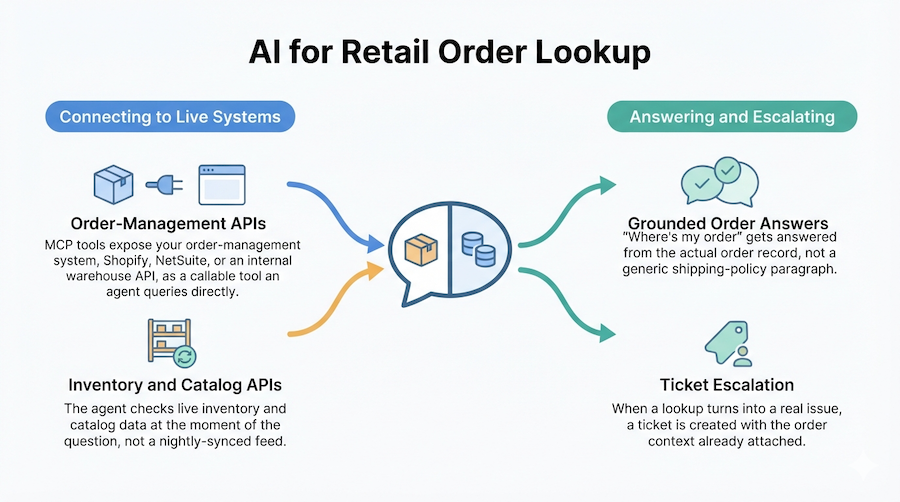
MCP tools expose your order-management system, Shopify, NetSuite, an internal warehouse API, as a callable tool an agent queries directly. "Where's my order" becomes a live API call to the actual order record, not a lookup against a stale product feed synced overnight.
Consider a shopper asking about a delayed shipment. A scripted bot matches "delayed" to a shipping-policy article and stops there, regardless of whether that order is actually delayed. A grounded agent instead calls the order-management API with the order number, reads back the actual current status, carrier, and expected delivery window, and only falls back to general policy language if there's genuinely nothing order-specific to report. The difference isn't tone or friendliness. It's whether the answer is checked against something real before it's given.
| Scripted chatbot | Grounded order-lookup agent | |
|---|---|---|
| "Where's my order?" | Generic shipping-policy text | Live status from the order system |
| "Is this in stock near me?" | Can't answer, or answers wrong | Live inventory check by location |
| Data freshness | Static or overnight sync | Real-time, at the moment of the question |
| Escalation path | Dead end, or hands off to a human blindly | Structured ticket with context attached |
From Lookup to Ticket: Handling the Cases That Need a Human
Not every order question resolves in one answer. Some need a real support case: a damaged item, a missing package, a refund dispute. The pre-built Ticket Management app handles that handoff structurally — an agent can create a ticket with the order context already attached, rather than a shopper repeating their order number to a human agent who's starting from zero.
That structured handoff is where the mechanism connects back to the same platform used elsewhere: the MCP App UI generates the actual ticket-creation form dynamically from the tool's schema, no separate front-end build required for the escalation path.
Catalog Q&A and Merchandising on Real Product Data
Beyond order status, a catalog Q&A AI agent answers the same connection pattern's merchandising questions, "does this come in a larger size," "what's similar to this item", from the actual product catalog rather than a chatbot's training data guess. The same grounded AI memory layer that grounds order lookups applies here: the agent checks the live catalog, not a snapshot.
This matters most during high-volume periods, a seasonal promotion or a product launch, when catalog and inventory data changes fastest and a stale snapshot is most likely to mislead a shopper. An agent connected directly to the catalog API answers "is this available in my size" correctly during a flash sale the same way it does on a quiet Tuesday, because it's checking the same live source either way, not a nightly export that's already out of date by the time traffic spikes.
Why This Matters Now
The cost of an ungrounded conversational commerce AI isn't hypothetical. It's measurable in conversion and in customer preference. AI-assisted chat interactions convert to orders at 23 to 27%, compared to roughly 12% for baseline web search, and shoppers who engage an AI chatbot convert at 12.3% versus 3.1% for those who don't, according to Gorgias' State of Conversational Commerce 2026 report. That gap only holds if the chatbot can actually answer the question correctly. A scripted bot that gives Marisol's shoppers the wrong answer erodes the same trust a grounded one builds.
Customer expectations already assume this works. 74% of customers prefer chatbots for simple questions like order status, per the same Gorgias report, and the global AI customer service market is projected to reach $15.12 billion in 2026, according to Zendesk's AI customer service statistics for 2026. The expectation is set. The mechanism behind the chatbot is what determines whether it's met or disappointed. It's the same grounding gap covered in AI for customer support more broadly — order lookup is simply that mechanism applied to retail-specific systems.
Getting Started
- Connect your order and inventory APIs as MCP tools. Whether that's Shopify, NetSuite, or an internal warehouse system, expose it as a callable tool an agent can query directly, no separate integration per storefront or channel.
- Configure an AI assistant for order lookup and inventory questions with that tool assigned. Point it at the order/inventory API, and a knowledge base of policies if relevant, so both live data and static policy questions get grounded answers from the same assistant.
- Set up the Ticket Management app for escalations. Configure the handoff so a real issue creates a ticket with order context already attached, instead of a shopper repeating themselves to a human agent.
- Test with real order numbers before going live. Confirm the agent's answers match what the actual order-management system shows, across both a normal case and an edge case like a delayed or split shipment.
Most retail support teams get a working order-lookup agent, connected to real data, running in a single session.
Frequently Asked Questions
What is AI for retail order lookup?
AI for retail order lookup is an agent answering order-status and inventory questions by querying your actual order-management and inventory systems directly through MCP tools, rather than matching pre-written responses to a shopper's phrasing.
Can AI check real inventory, not just answer FAQs?
Yes, when the agent is connected to the inventory system as an MCP tool. It queries live stock data at the moment of the question instead of relying on a static or overnight-synced product feed.
What happens when an order question needs a human?
The pre-built Ticket Management app creates a support ticket with the order context already attached, so a human agent picks up with full information instead of starting the conversation over.
Does this require replacing our e-commerce platform?
No, this is retail AI without replatforming. MCP tools expose your existing order-management, inventory, and catalog APIs, Shopify, NetSuite, or an internal system, as callable tools. Nothing about the underlying platform needs to change.
Why do scripted chatbots fail at order-specific questions?
Because they match a shopper's phrasing against pre-written responses rather than querying a real system. "Where's my order" has no correct scripted answer. It depends entirely on data the bot was never connected to.
Can this handle high-traffic periods like a seasonal sale?
Yes. Because the agent queries live inventory and order data at the moment of each question rather than a scheduled export, it stays accurate whether traffic is quiet or spiking, unlike a nightly-synced feed that goes stale fastest exactly when demand is highest.
Common Objections, Answered With the Mechanism
Retail support leaders tend to raise the same concerns before adopting a grounded order-lookup agent.
"What if it gives out the wrong customer's order information?" The same Access Control model used elsewhere answers this. The agent should only be able to query order data scoped to the authenticated shopper asking, not an open lookup across every order in the system.
"What if the API is down?" A clear fallback answers this one. The agent surfaces that live data is temporarily unavailable rather than guessing, and can still hand off to a ticket with whatever context it does have.
"Won't this need constant retraining as our catalog changes?" The architecture answers it. There's no model retraining involved. The agent queries the live catalog and inventory API directly, so a catalog update is reflected the moment it's live in that system, not after a retraining cycle.
AI for Retail Order Lookup: The Bot That Actually Checks
Marisol's chatbot wasn't broken because it was poorly written. It was broken because it had nothing real to check against. AI for retail order lookup fixes that with a direct connection to the order-management and inventory systems those questions actually depend on, with a structured path to a human ticket when the answer genuinely needs one. It's one of several ways teams put grounded AI to work, see other use cases across support, sales, and ERP, including the same live-lookup mechanism applied to CRM pipeline and account data.
Sign up free, no credit card required, and connect your first order or inventory API as an MCP tool today.
Related reading
Ready to put this into practice?
Talk to us about your stack