Is Artificial Wit an AI Operating System? The Architecture
Is "AI operating system" just marketing? See the real, unified AI platform architecture: agents as processes, LLMs as swappable hardware. Try it free.
By Artificial Wit Team
By Artificial Wit Team. Last updated: July 6, 2026.
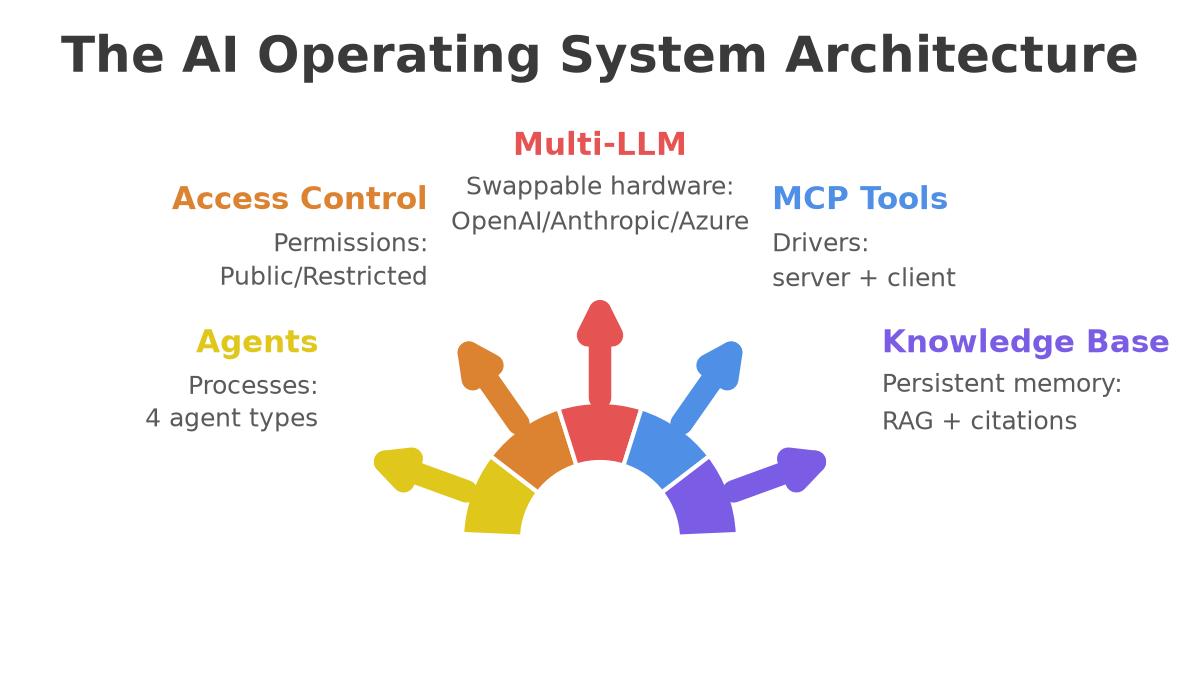
Calling something an "AI operating system" is usually marketing with no architecture behind it. In Artificial Wit's case, the term maps to a real structure: agents run as processes, LLM providers swap in and out like hardware, MCP tools act as drivers, and one Access Control model governs permissions across all of it.
Carlos was a solutions architect evaluating AI platforms for a mid-size insurer. The phrase "AI operating system" had appeared in three vendor decks that quarter. He'd stopped taking it seriously. It wasn't until he asked one vendor to actually map the term to something specific that he got a straight answer — and it happened to be this one.
This article does what Carlos asked for: it maps the operating system metaphor to Artificial Wit's actual, shipped architecture, piece by piece, so you can judge for yourself whether the label means anything or not.
- "AI operating system" isn't a shipped feature on its own. It's a description of how five existing capabilities fit together: agents, Access Control, multi-LLM configuration, MCP tools, and the Knowledge Base.
- Agents run as one of four types (Standard, Sequential, Parallel, Loop), the closest real analogue to processes running on an operating system.
- LLM providers (OpenAI, Anthropic, Azure, Gemini, local models) register and swap like hardware, without rebuilding the agents or tools running on top of them.
- MCP tools function like drivers — a standard interface between the "operating system" and the systems it talks to, both as a server exposing your APIs and a client connecting to external ones.
- SSO and SCIM are not yet shipped. If "enterprise operating system" implies identity federation to you, that specific piece isn't there today.
What Does "AI Operating System" Actually Mean?
An AI operating system, in the way this article uses the term, is a platform where agents run as managed processes, LLM providers are swappable like hardware, and one governance layer controls permissions across everything, rather than a single AI feature you buy off a menu. It's an architecture description, not a product category with an agreed definition.
That distinction matters. Most uses of the phrase in AI marketing describe a feeling, not a structure. This article commits to the opposite: every claim below maps to a specific, already-shipped part of Artificial Wit, listed by name so you can verify it yourself in the product.
The Architecture, Mapped Concept by Concept
Here's the full mapping, operating system concept to Artificial Wit feature, with nothing in this table left as an unproven assertion.
| OS concept | Artificial Wit equivalent |
|---|---|
| Processes | Agents (Standard, Sequential, Parallel, Loop) |
| Permissions | Access Control (Public/Restricted, 8 resource types) |
| Swappable hardware | Multi-LLM provider registration (OpenAI, Anthropic, Azure, Gemini, local) |
| Drivers | MCP tools, both server and client |
| Persistent memory | RAG Knowledge Base |
Agents as Processes
An operating system runs multiple processes, each with its own scope and lifecycle. Artificial Wit's agents work the same way. Each agent runs as one of four types, Standard for a single-turn answer, Sequential for ordered multi-step work, Parallel for concurrent steps, or Loop for repeating until a condition is met. Each agent has its own system prompt, assigned LLM, knowledge base access, and tool assignments — the same way a process has its own memory space and permissions.
Access Control as Permissions
An operating system's permission model decides which process can touch which file or device. Artificial Wit's Access Control model does the equivalent job across the platform. Every resource — agents, knowledge bases, LLM models, APIs, credentials, variables, users, and pages — is either Public or Restricted to specific roles and users.
The full mechanics of this model are covered in depth elsewhere. Here, the point is narrower: this is the permissions layer the OS metaphor depends on, and it's real, not aspirational.
| Resource type | Governed the same way |
|---|---|
| Agents | Public or Restricted to roles/users |
| Knowledge Items | Public or Restricted to roles/users |
| LLM models | Public or Restricted to roles/users |
| APIs | Public or Restricted to roles/users |
| API Credentials | Public or Restricted to roles/users |
| Global Variables | Public or Restricted to roles/users |
| Users | Public or Restricted to roles/users |
| Pages | Public or Restricted to roles/users |
One honest gap in this analogy: an enterprise operating system typically includes identity federation, SSO, SCIM provisioning. Artificial Wit doesn't have either shipped yet. If "AI operating system" implies that to you, that specific piece isn't here today.
Want to see the permission model firsthand? Explore Artificial Wit's AI Assistant to check the Access Control screen yourself.
Multi-LLM as Swappable Hardware
An operating system abstracts away the specific hardware a process runs on. Artificial Wit does the equivalent for the model underneath an agent.
Admins register multiple LLM providers, OpenAI, Anthropic, Azure, Gemini, local models. Each one gets its own temperature, max tokens, and active/inactive toggle.
An agent's assigned model can change without rebuilding its prompt, tools, or knowledge base assignments. That's the same way a process doesn't need to be rewritten when it runs on different hardware.
MCP Tools as Drivers
Drivers give an operating system a standard way to talk to hardware it doesn't control directly. MCP tools do the same job for external systems in this AI operating system.
As a server, Artificial Wit exposes your own APIs as MCP tools that any compatible client can call. As a client, it connects out to external MCP servers that other teams or vendors host.
Both directions use the same standard interface. That's the same way a driver abstracts one specific device behind a common API.
The Knowledge Base as Persistent Memory
An operating system needs persistent storage that survives past any single process. The RAG Knowledge Base plays that role in this AI operating system: documents, URLs, and notes ingested once, with citations attached to every answer, available to any agent assigned to read from it. Memory in this sense isn't the model's context window. It's the durable store agents draw from across sessions.
Ready to see the pieces work together? Create a free account, no credit card required, and configure your first agent against a real knowledge base and model.
Example: Running Multiple "Processes" on One AI Operating System
Ingrid led platform engineering for a logistics company running three distinct AI workflows: a customer support agent, a compliance-review agent, and a nightly Loop agent that reconciled shipment records. Before consolidating, each one had been built as a separate integration project — its own model choice, its own access rules, no shared architecture between them.
Once Ingrid moved all three onto one platform, the operating-system framing stopped being theoretical. The support agent ran as Standard, answering one question at a time. The compliance agent ran Sequential, pulling a document, checking it against a policy, then producing a summary. The reconciliation agent ran as a Loop, repeating nightly until every shipment matched. All three drew from the same Access Control model. And all three could be pointed at different LLM providers without anyone touching the underlying tool or knowledge base configuration.
Nothing about adding a fourth agent later required new infrastructure. It required configuring a fourth process on a platform that already handled permissions, model access, and tool calling the same way for the first three.
AI Operating System vs. AI Assistant Platform
An AI assistant is one process running on top of this architecture, not the architecture itself. A white-label AI assistant is a specific, branded chat interface, useful and real, but it's one workload among several the platform can run.
Calling the whole platform an operating system, and a single assistant a process on it, is the distinction this article has been building toward. The architecture is the layer that lets several different AI workloads share the same governance and model infrastructure, instead of each one becoming its own integration project.
| AI Assistant (one workload) | AI Operating System (the platform) | |
|---|---|---|
| Scope | A single branded chat interface | Every agent, tool, and model running on the platform |
| Governance | Inherits Access Control from the platform | Defines Access Control across all 8 resource types |
| Models | Uses whichever model its agent is assigned | Registers and swaps every provider platform-wide |
| Adding a new workload | Not applicable, it is one workload | Configure a new agent type against existing infrastructure |
Why the Architecture Matters More Than the Label
The label isn't the point. That matters especially for an AI operating system for enterprise use, where IT has to trust the label enough to bet real workloads on it. The outcome is what matters: swapping an LLM provider, adding a new agent, or restricting a knowledge base doesn't require re-architecting anything.
Artificial Wit already handles that as one platform for agents, tools, and models, not five separate integration projects bolted together. That's a genuinely different starting position than assembling a chat UI, a vector database, and a model API on your own, then hoping they stay compatible as requirements change.
Ingrid's team didn't rebuild anything to add a fourth agent. Carlos, evaluating from the outside, got a concrete architecture to check instead of a slogan. Both outcomes come from the same underlying platform working the same way, regardless of which workload runs on top of it.
Getting Started: Configure Your First "Process"
- Register at least one LLM provider. Add OpenAI, Anthropic, Azure, or a local model, set temperature and max tokens, and mark it active.
- Create a Knowledge Base. Ingest a document or URL so an agent has persistent memory to draw from, with citations attached to its answers.
- Configure your first agent. Pick Standard, Sequential, Parallel, or Loop, assign it a model and a knowledge base, and set its Access Control.
- Add an MCP tool if the agent needs one. Expose one of your own APIs as a server tool, or connect to an external MCP server as a client.
Most teams get one agent running end to end, model, memory, permissions, and tools all configured together, in a single working session.
Frequently Asked Questions
What is an AI operating system?
An AI operating system is an architecture where AI agents run as managed processes, LLM providers swap in and out like hardware, and one Access Control model governs permissions across every resource, rather than a single standalone AI feature.
How is an AI operating system different from an AI assistant?
An AI assistant is one workload, typically a branded chat interface, running on top of the architecture. An AI operating system is the underlying layer that lets that assistant, plus other agents and workflows, share the same governance and model infrastructure.
Can you swap the underlying LLM without rebuilding your AI setup?
Yes. LLM providers are registered independently of the agents, tools, and knowledge bases that use them. Changing an agent's assigned model doesn't require rebuilding its prompt, tool assignments, or knowledge base access.
Does calling something an "AI operating system" mean anything technical, or is it just marketing?
It depends entirely on whether the vendor can map the term to specific, shipped capabilities. For an AI operating system built for enterprise use, that means every layer — agent scheduling, permissions, model access, and tool calling — has to be independently verifiable in the product, not just asserted in a slide.
The Architecture Behind the Label
An AI operating system only means something if it maps to a real structure. Here it does: agents running as processes, Access Control governing permissions, LLM providers swapping like hardware, MCP tools acting as drivers, and a Knowledge Base serving as persistent memory. None of these pieces is new information in isolation. What's different is that Artificial Wit was built as one unified AI platform architecture for enterprise use, not five separate integration projects.
Carlos got the concrete answer he'd stopped expecting from a vendor deck. Ingrid's team added a fourth agent without touching the infrastructure the first three already ran on.
Sign up free, no credit card required, and see the AI operating system for yourself: configure an agent, assign a model, and set its access control in one session.
Related reading
Ready to put this into practice?
Talk to us about your stack