Procure-to-Pay Software That Doesn't Stop at Payment
Procure-to-pay software usually stops at payment. See a six-stage P2P workflow that also owns maintenance, depreciation, and disposal, in one platform.
By Artificial Wit Team
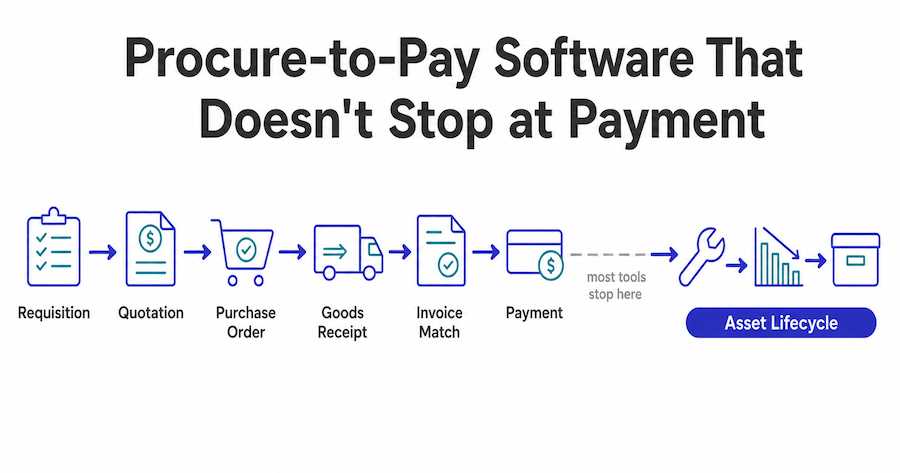
Procure-to-pay software manages six stages: requisition, quotation, purchase order, goods receipt, invoice matching, and payment. Most tools stop exactly there. What happens to the asset afterward gets left to a spreadsheet or a second piece of software. A purchased laptop, once paid for, becomes someone else's problem. Someone has to track who has it, schedule its maintenance, calculate its depreciation, and eventually retire it properly.
Priya ran operations for a 60-person engineering firm. She had two separate systems: Precoro for procurement, and a shared spreadsheet everyone half-updated for tracking which laptop belonged to which employee. When a device broke and needed warranty service, she had to cross-reference the purchase date in Precoro against a depreciation schedule nobody had touched since the spreadsheet was created. Answering a question that should have taken twenty seconds took her twenty minutes.
This guide covers the full six-stage procure-to-pay process and what happens to an asset after the purchase completes. It also covers why splitting procurement and lifecycle management across two tools creates exactly the gap Priya ran into.
- Procure-to-pay covers six stages: requisition, quotation, purchase order, goods receipt, invoice matching, and payment.
- Most P2P tools (Precoro, Procurify, Coupa) stop at payment; asset lifecycle (maintenance, depreciation, disposal) is a separate problem they don't own.
- Three-way matching (PO, invoice, goods receipt) verifies a bill before it's paid, preventing overpayment and fraud.
- Depreciation forecasting and preventive maintenance scheduling work off the same asset record created at goods receipt, not a disconnected spreadsheet.
- Every procurement and asset record is queryable via MCP, so "is this laptop still under warranty" has an actual answer, not a twenty-minute cross-reference.
The six stages, requisition to payment
The procure-to-pay cycle runs through six documented stages, each producing its own record type:
- Requisition (PR), a request to purchase, routed for approval based on its value.
- Quotation (RFQ/QT), vendor comparison before committing to a purchase.
- Purchase Order (PO), the formal order, with automatic calculations for totals and taxes.
- Goods Receipt (GRN), confirms delivery and automatically creates the asset record.
- Invoice Matching (INV), three-way verification against the PO and goods receipt before payment.
- Payment (PAY), includes overpayment prevention, checking what's already been paid against what's owed.
Documents are draft-first. Nothing commits until submitted, and once approved, a document becomes read-only rather than silently editable. Numbering is gap-free and sequential, so there's no missing PO number to explain during an audit.
See the full six-stage workflow in your own account. Sign up free, no credit card required.
Three-way matching: how a bill actually gets verified
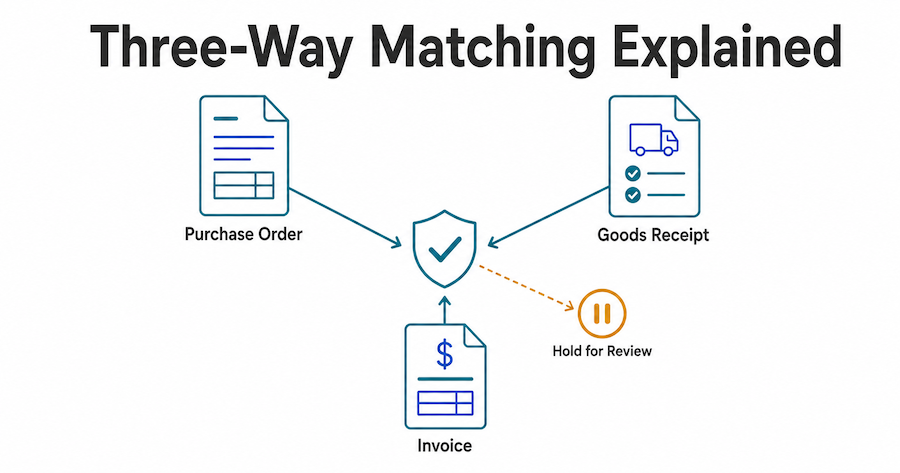
Three-way matching checks that the purchase order, the vendor's invoice, and the goods receipt all agree on item, quantity, and price before payment goes out. If a vendor bills for 50 units but the goods receipt only confirms 45 delivered, the mismatch holds the payment rather than releasing it automatically. For the full mechanism, including what happens after a mismatch gets resolved, see three-way matching explained.
This is the same verification standard used by procurement specialists like Precoro. Here, it's one stage in a workflow that continues past payment into the asset's actual lifecycle, rather than ending the moment the bill clears.
What happens after the purchase: asset lifecycle
The goods receipt stage doesn't just close the procurement loop. It automatically creates the asset record: registered, allocated to a location or owner, and tracked from that point forward. From there:
- Preventive maintenance runs on recurring service schedules, so upkeep is scheduled rather than reactive. (Meter-based maintenance, triggered by usage instead of a calendar, isn't supported yet. Worth knowing before you assume a specific maintenance model will fit.)
- Depreciation forecasting posts period-by-period, so an asset's current book value is always current rather than recalculated once a year during an audit scramble.
- Disposal happens through documented retirement, not deletion, preserving the record of what happened to an asset rather than erasing it.
Marcus managed IT assets for a 120-person company. He used to dread the annual depreciation review, because it meant reconstructing a year of purchase dates and useful-life assumptions from scratch in a spreadsheet. Once depreciation posted automatically period by period from the same record created at goods receipt, the annual review became a five-minute check instead of a multi-day reconstruction project.
Keeping the record honest: verification and discovery
Physical verification audits reconcile what's on the books against what's actually in a location or category. They catch the gap between "the spreadsheet says we own this" and "we can actually find it." Network discovery scans complement this on the software side. They surface installed software that was never formally registered — the shadow-IT problem specialists like Zylo and Zluri focus on almost exclusively.
| Verification type | What it catches |
|---|---|
| Physical audit (by location/category) | Assets that exist on paper but aren't where records say |
| Network discovery scan | Software installed but never registered as an asset |
| Three-way match | Invoices that don't match what was actually ordered and delivered |
Support and SLAs for the assets you manage
A built-in helpdesk tracks support requests against SLA targets and flags breaches when they happen. Escalation on a breached SLA is currently manual rather than automatic. A flagged breach still needs someone to act on it — it's a flag, not an autonomous escalation.
Querying assets and procurement from Claude or ChatGPT
Every procurement and asset record sits behind the same MCP endpoint used across the platform. A question like "is this laptop still under warranty" or "which purchase orders are pending approval over $5,000" gets answered from live data — the same real-time-lookup pattern already documented for retail order and inventory queries. The dynamic forms used for asset requests are generated from the same schema-driven MCP App UI mechanism used elsewhere on the platform.
Ready to connect your procurement and asset data to Claude? Sign up free and turn your first workflow into a queryable one.
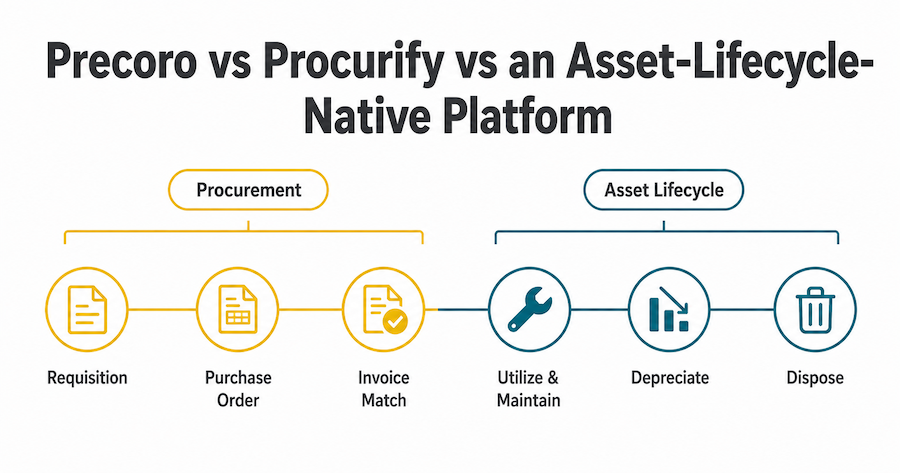
Where this fits vs. Precoro, Procurify, and enterprise S2P
Precoro publishes itemized pricing starting around $499/month and handles procurement, especially three-way matching, well for budget-conscious teams. Procurify fits mid-market teams wanting fast intake-to-pay workflows. Coupa and SAP Ariba serve large enterprises with dedicated procurement teams and the budget for consultant-led implementation.
None of them are wrong choices. None of them are being out-featured here on their own turf, either — enterprise scale, deep ERP integrations, and dedicated procurement-team workflows are real strengths Coupa and Ariba have that a smaller platform shouldn't claim to match. The honest gap this fills: a team that's outgrown a spreadsheet but doesn't need Coupa's complexity, and doesn't want to run procurement in one tool and asset lifecycle in another.
Frequently asked questions about procure-to-pay software
Can I register an asset without going through the procurement workflow? Yes, direct asset entry is supported for assets that didn't originate through this platform's own requisition process.
How does three-way matching actually verify an invoice? It compares the purchase order, the vendor's invoice, and the goods receipt on item, quantity, and price. A mismatch outside acceptable tolerances holds the payment rather than releasing it.
How does depreciation get posted? Depreciation forecasts and posts period-by-period, calculated from the asset record created at goods receipt.
Who can access procurement and asset records? Access follows the same role-based model used across the platform, restricted based on the requesting user's assigned permissions.
Does this support consumable inventory? Not currently. This is asset and procurement tracking, not consumables management — don't expect it to handle items meant to be used up rather than tracked as durable assets.
Can I ask an AI assistant about my asset inventory? Yes, through the same MCP endpoint that exposes procurement and CRM data, subject to the requesting user's existing access permissions.
Getting started
The gap between procurement software and asset-lifecycle software is exactly where a purchased asset tends to get lost. It's tracked in one system up to the moment of payment, then handed off to a spreadsheet for everything after. Closing that gap doesn't require Coupa-level complexity or a second tool. It requires one record that follows the asset from requisition through disposal.
Sign up free and try the full procure-to-pay workflow → No credit card required.
Related reading
Ready to put this into practice?
Talk to us about your stack